I often treat my life like a series of summits to be conquered. I pack my schedules, set my internal “train mode” to high, and steam ahead toward the next milestone, convinced that the finish line is where the meaning lives.
and what happens when the mountain doesn’t care about my schedule?
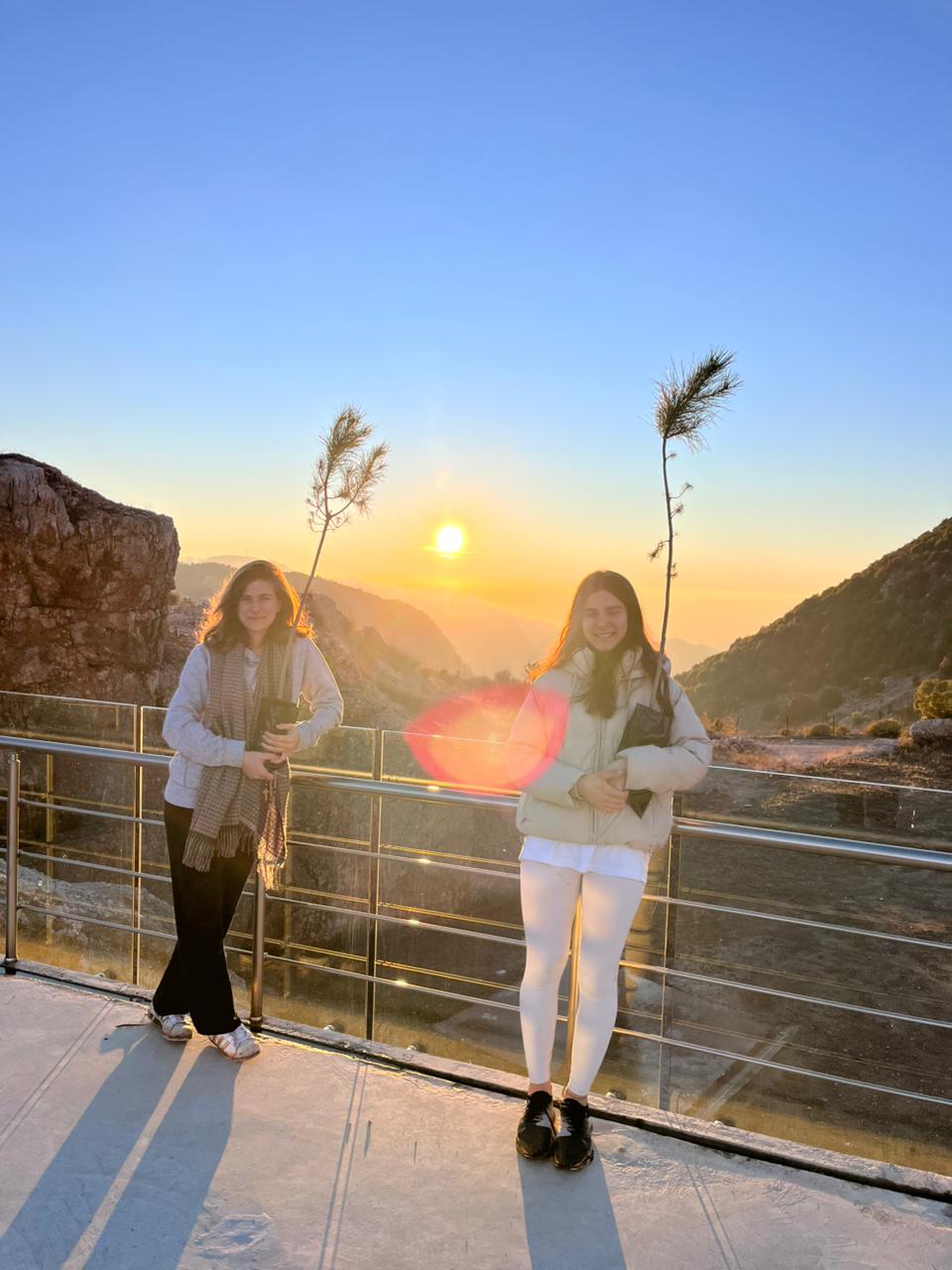
Last week, my sister and I hiked Jabal Moussa, a Unesco Biosphere Reserve in Lebanon that feels less like a trail and more like a portal into another time. We went in with no water, no plan, and a lot of “doing” energy. What followed was excitement followed by desolation, a humbling encounter with a 70-year veteran of the slopes, and a realization that my greatest strength — my drive — was also the thing keeping me from the “dance.”

As we navigated the dense Iron Oak forests and ancient Roman stairs, the path only revealed itself step-by-step. I started in my typical “doing” mode—adamant and hyper-focused. My sister kept calling me out on it; she says I go into my “train mode.” I was a locomotive, head down, steaming toward a destination I couldn’t even see yet.
In that mode of operation, I feel almost blind, deaf, unconscious. I’m so much in the doing that it hurts me to even stop to think. Only later I come to realize it and usually feel sad about how often I am just “doing” my life instead of actually living it.

The Oracle and the Mirror
In the middle of my frantic pace, we met an oracle. A shepherd, trailing a sea of 300 goats, who had been walking these same slopes for 70 years. Can you imagine? Seven decades of the same rhythm.


As we spoke to him, I felt a wave of “stupidity.” I was standing there, checked-out and obsessing over the finish line. He was just there. I was trying to conquer the trail; he was inhabiting it. My “doing” felt shallow and hurried compared to his “being.”
That intensity is useful in short bursts, but as I’ve learned from countless burnouts, it is not sustainable. This time, it led to a dangerous overconfidence. We got lost because I was too busy “succeeding” and my sister was too busy trying to catch up.


The Choice at the Crossroads
We eventually traced our steps back to a fork in the trail. Two choices arose: turn back the way we came—safe, predictable, and shorter—or continue onto the “new” trail into the unknown. My instinct was to retreat to the known. But my sister had a different view. She wanted the adventure; she wanted to see the trail we hadn’t crossed yet.
This is where the journey shifted from a hike into a dance.
I was mentally depleted from pathfinding. I realized that if we took the new route, I needed to follow. In that moment, we discovered a strange alchemy: the very thing that was draining me was exactly what energized her. The responsibility of leading—scanning for markers and “breaking” the trail—had exhausted my mental reserves. But the moment I stepped back and let her take over, she came alive. My “burden” became her “purpose.”


The Dead Zone
When one of us was “asleep” or dependent, the other woke up. We weren’t two individuals competing for the summit; we were a single unit, alternating who carried the “mental drain” of the path. But even with the dance, the mountain eventually demanded its toll.
I hit the 75% threshold—the “Dead Zone.” This is where the initial excitement has evaporated, the finish line is a ghost, and the body begins to rebel. I began to crumble. I was exhausted, thirsty, and impatient.
Because Jabal Moussa is a pristine wilderness, there are no safety nets. My lack of planning became a mirror for my character. I found a few snacks in my pocket I’d forgotten I had, and for a split second, I became a survivalist. I thought about eating them in secret—after all, she didn’t know they existed. I was angry at the thirst and the heat, and my ego wanted to protect itself first.

The Cure for Bitterness
But then, my sister broke. She began to cry—a mix of hunger, exhaustion, and the sheer weight of the trail. Her vulnerability “woke me up” from my selfish spiral.
I reached into my pocket and gave her the snacks—all of them. In that moment, giving was the only thing that could save me. Giving her that last bit of fuel was the cure for my own bitterness. It is impossible to be resentful and compassionate at the same time.
Once I passed that 75% point of wanting to give up, something shifted. The “second wind” isn’t a myth; it’s what happens when you finally stop “doing” the mountain and start “being” on it. The energy returned because I had stopped fighting with my partner, stopped fighting myself, and finally surrendered to the climb.
Like the shepherd, I realized that the point isn’t to get off the mountain. The point is to learn how to dance with it.
Looking back at these photos, I realized how harsh I was being on myself in the moment. I called my focus ‘train mode’ as if it were a flaw. I felt ‘stupid’ next to the shepherd’s 70 years of peace. But the mountain isn’t there to judge us; it’s there to hold a mirror up to us.
My ‘doing’ isn’t a mistake—it’s my energy. The lesson wasn’t to kill the locomotive inside me, but to learn when to let someone else take the controls so I can finally look out the window and see the view.
